

Pecking or Soaring
🐓🕊️ On attention, courage, and choosing the signals that carry us forward

We call ourselves ‘headless chickens’ when life feels like a sprint with no finish line. We say we ‘chicken out’ when fear overtakes courage and we abandon something tender before it can grow. But there is another way we behave like chickens too. In how we consume content.
Peck. Peck. Peck. A headline here. A meme there. A half truth wrapped in outrage, or optimism without roots. We skim the surface of everything and sink into nothing. Our attention fractures. Our energy thins. Our imagination starves.
There is a famous fable called Morir en la pavada by Mamerto Menapace. The title alone already says so much: to die in triviality, to waste a life on nonsense. The literal translation is “To die in the rafter”. A rafter is a group of turkeys. Imagine the sound of that for a moment: all those turkeys and their gobble, gobble, gobble. If we could put a sound to our social media feeds, that would be it…
Dying in Triviality, an ode to Mamerto Menapace
To be always on the run
without knowing from what or why,
spending life on empty noise,
losing oneself in foolishness.
Talking without saying anything,
listening without really hearing,
believing you are living fully
while time slips through your hands.
And one day waking up tired,
with no memory of having chosen,
realizing too late
that you died in triviality.
Menapace’s fable is devastating. And liberating. Because it names what many of us feel, holding a mirror to our reality. (I’ve translated it and if you’re into fables, you can read it at the foot of this article.)
This fable reflects a conundrum that is as old as humanity but which has been accelerated by digital technologies and AI. We are exhausted not because life is too full, but because it is too scattered. We are informed, but not nourished. Stimulated, but not moved.
So the question becomes: how do we transform ourselves? How do we transcend this chicken behavior and rise into flight, like condors?
Not by consuming better noise. But by listening inward for the signals.
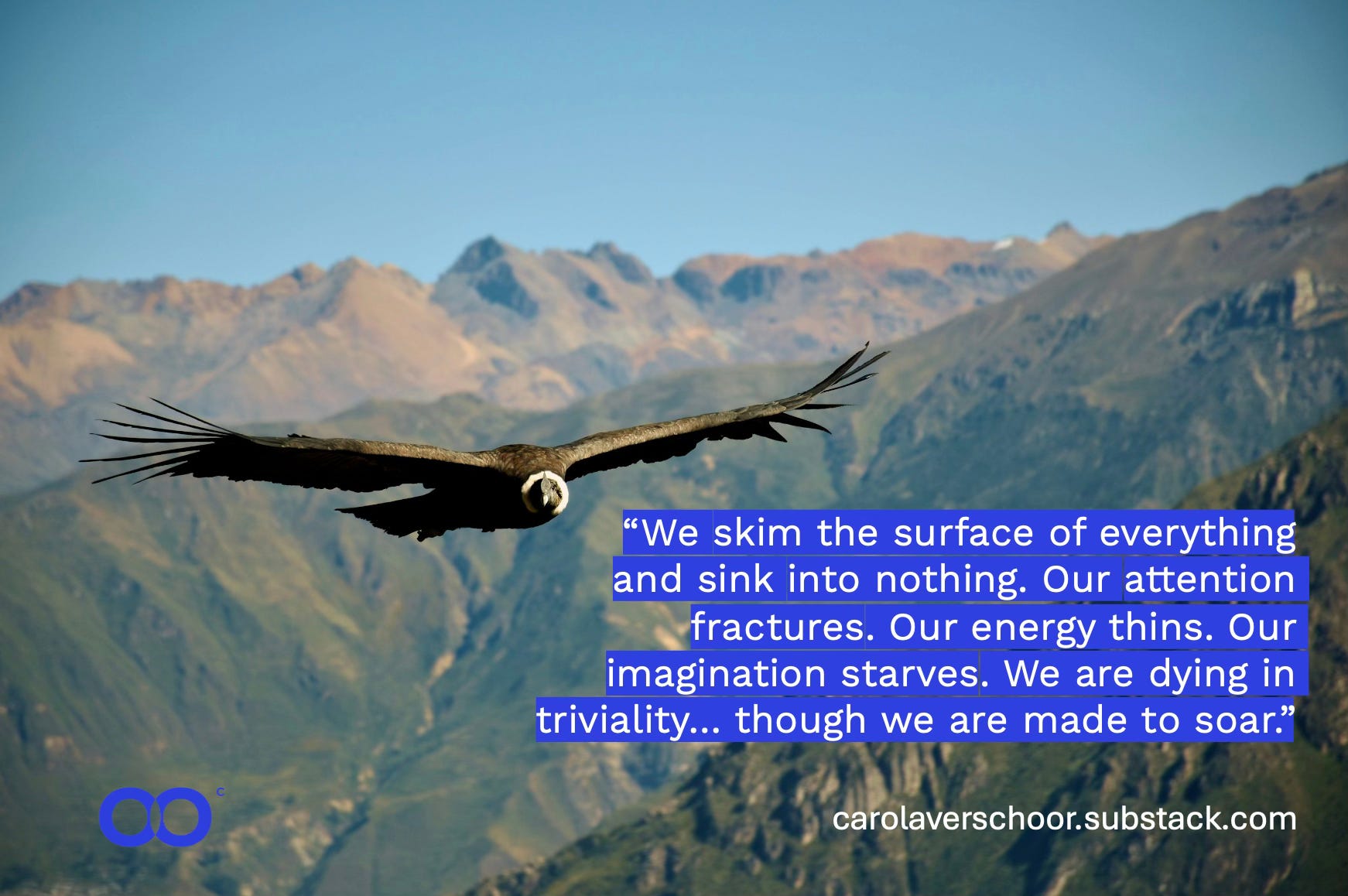
Real transformation does not require more inputs. It requires better discernment. By learning to sense what actually matters to us, before we let the world tell us what should.
Discernment is a practice. A daily tuning of attention toward what expands us rather than drains us. Toward what invites depth instead of speed and what opens futures rather than loop us into reaction.
Signals rarely arrive as breaking news. They arrive as quiet recognitions. A sentence that stays with you. A conversation that shifts your breath. A story that makes you feel more yourself, not less. These are not loud. They are resonant.
To detect them, we need to cultivate inner signal over outer noise. That means trusting your own nervous system as a compass. Noticing when something contracts you, and when something widens your field of possibility. Asking not, “Is this trending?” but, “Is this true for me?” Sensing what it is that makes you care, what calls to you in the midst of so much noise.
The world does not need smoother versions of us. It needs stranger ones. Quirkier ones. Our awkwardness is not a flaw. It is a feature of aliveness. Blending into the rafter of turkeys makes us less unique, less human and less connected.
When we embrace our true selves, not the optimized selves but the honest ones, something shifts. We stop pecking at fragments and start feeding on meaning. We stop scrambling and start choosing. We stop dying in triviality and start living in alignment.
Transformation, then, is not about becoming better chickens. It is about remembering that we were meant to soar.