

The Questions We Avoid
🐘 On acknowledging the elephant to move the system, and the power of rituals

This is the fourth article in the series: Shifting Systems
Every system shifts: some quietly, others all at once. Shifting Systems grew from conversations with readers exploring how systems learn and adapt. It views instability as a design opportunity, asking what happens when we don’t act, who holds responsibility, and how we build more living ways of organizing. Transformation isn’t change: it’s our creative, courageous response to it.
Article 4 of 7 | SHIFTING SYSTEMS SERIES
The Questions We Avoid
🐘 On acknowledging the elephant to move the system and the power of rituals
I notice it often in meetings, workshops, and organizations: the elephant in the room sits there, obvious and enormous, and yet no one names it. We circle around it, politely acknowledge symptoms, beat around the bush, and then move on. We avoid the questions that matter most: the ones that could catalyze transformation.
Avoidance is a natural impulse. Confronting the truth is uncomfortable. It challenges authority, threatens identity, and exposes vulnerability. Yet transformation can only take place when we confront the avoidance. Transformation requires courage to ask the hard questions, to probe beneath the surface, to acknowledge what is often unspoken.
Asking the right questions is a form of participation. It refuses passivity and calls the system to awareness. Avoiding questions may preserve comfort in the short term, but it prevents learning, growth, and adaptive action.
Feeling is a way of knowing
I recall a client whose system was clearly failing in several areas: customer feedback was ignored, internal processes clogged, and morale was low. Everyone knew it. Everyone felt it. Yet meetings focused on incremental efficiency improvements rather than addressing the underlying misalignment. The organization was paralyzed by fear of facing the real challenge. It was perceived as threatening, for it would indeed rock the boat and no one knew what might happen then…
Until it was no longer dismissible. The cracks became contours of a truth too urgent to ignore. The boat was not just rocking, it was sinking. What had been whispered in corridors was made its way to the boardroom. The top of the organization, who had been far away from the reality of the operation, realised how bad things were. It’s not just a matter of naming the elephant: that was already happening. It was acknowledging the elephant that led the board members into action.
So we decided to transform the way everyone engaged with each other, and with the organization. Focusing on quality of interaction rather than the effectiveness of the processes. That was when we began to shift the system: beyond strategy, through the creation of safe circles. We gathered people to speak, to listen, to reconnect with why they came to work in the first place. In those early sessions, the discomfort was palpable and the rituals unfamiliar, the silence thick. So we designed rituals that could help evolve the culture in ways that met people where they were.
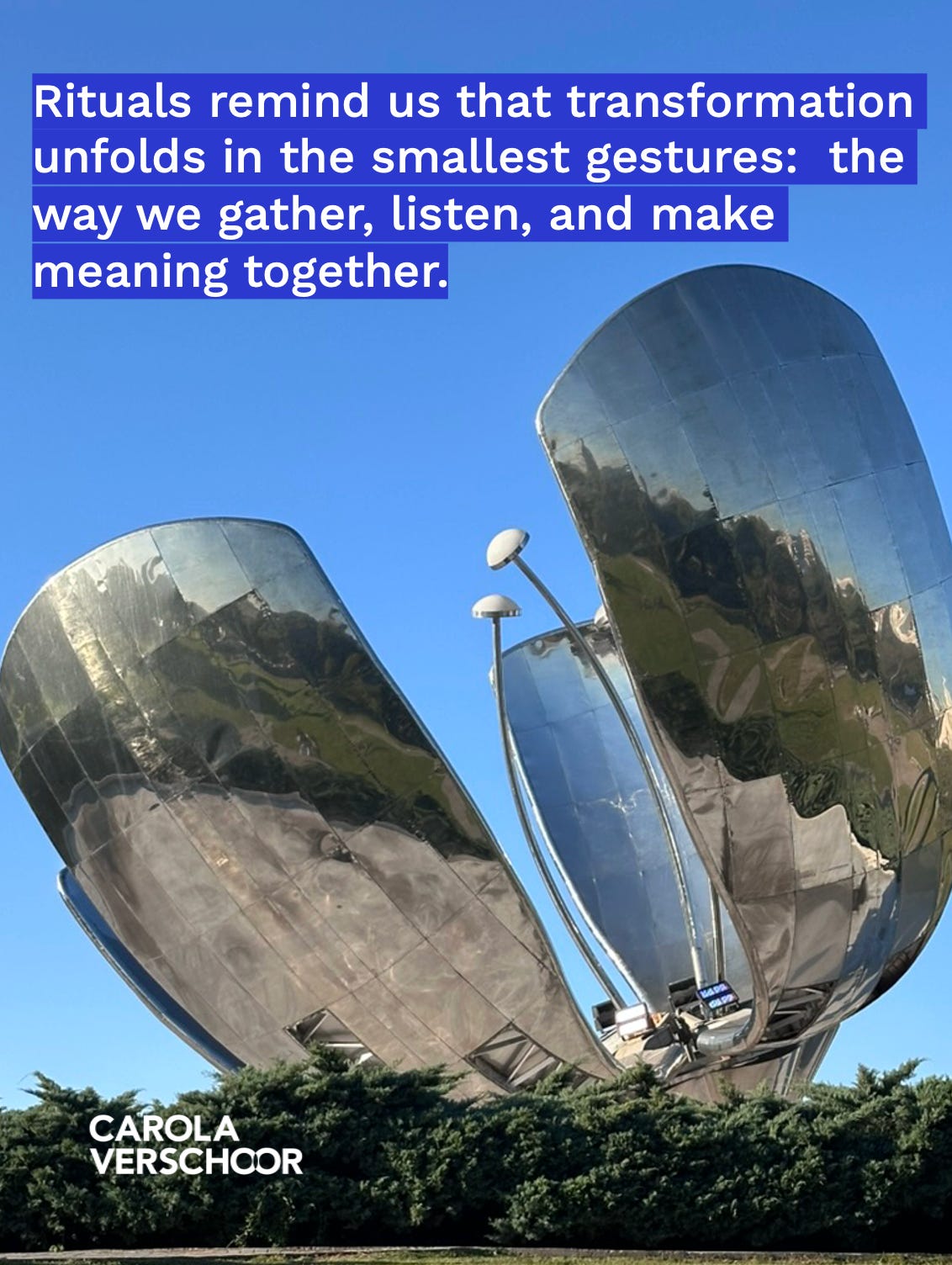
Rituals helped to remind us that transformation unfolds in the smallest gestures: the way we gather, listen and make meaning together. As awkward as that was initially, for we were switching gears.
“Despite the fact that they think the thing is ridiculous, it can over time start to mean something to them — and they then feel differently about their coworkers and their work.” - prof. Michael Norton
The power of rituals
Michael Norton (professor at Harvard Business School), known for his research on behavioral science, meaning, and rituals in organizational and personal contexts was one of the sources of wisdom I turned to in creating these interventions. His work explores how people find purpose and belonging at work, and how rituals can create cohesion, reduce anxiety, and improve performance within teams and organizations.
Through these sharing circles, a quiet alchemy began. The team started to invent its own small ceremonies: opening meetings with a check-in round, closing projects with a collective reflection or when necessary a post-mortem, marking transitions with gestures of appreciation. These acts seemed simple, but they shifted the atmosphere.
“We use rituals to change our emotional states in many different ways … to calm ourselves down, to amp ourselves up, and to connect with others.” The organization slowly found its pulse again — not through process optimization, but through rehumanization.” -prof. Michael Norton
Each ritual was designed to have three layers, just as Norton describes: a physical element, a communal one, and a psychological one. Words, gestures, meanings. Over the period of several months, these repeated acts became a shared language for belonging. Meetings turned into moments of meaning-making. Decisions grew from conversation, not compliance.
What emerged was not a top-down transformation plan but a living pattern of practice. A future being rehearsed, together.
The lesson is as simple as it is powerful: the questions we avoid are often the ones that reveal responsibility. They illuminate who is accountable, what assumptions are limiting us, and which structures no longer serve the system. Avoidance is a subtle form of delegation: we hand the problem to someone else, to time, or to the hope that the environment will validate our assumptions.
Breaking the pattern of avoidance
Designing for transformation asks us to break this pattern. It asks us to cultivate awareness and embrace inquiry as a tool, not a threat.
It starts by feeling into what is happening. Because when we feel, we activate our senses. And there’s a lot of information we can access in that space. I’ve shared this in my TEDx talk, you can watch a fragment here.
As our world becomes more and more dependent on rational thinking and increasingly dependent on Artificial "Intelligence”, we seem to be reinforcing the pattern, rather than breaking it.

Frankly, I welcome this (r)evolution. Ultimately, AI points us in the direction of the patterns so that we see their non-’sense’. We are entangled and enmeshed in systems and cultures that feed into that avoidance. Because the avoidance is precisely what keeps those systems in place.
But as I once heard someone say: “The status quo has got to go.” A simple statement, with a little rhyme and lots of truth in it. So how do we break free from this pattern? How do we pick up the courage to be (r)revolutionaries?
The quest for questions
We might start by asking: What is alive in this system? Where is tension concentrated? Which truths are we refusing to name? These questions do not always have immediate answers, but asking them sets the system in motion toward adaptation.
The ‘place’ from which we are able to ask the questions is not the current system. It is the desired future. Desire is an incredibly powerful force, which sends ripples of resonance to others who desire the same kind of futures.
I believe that while fear of exposure is natural, so is imagination. By naming the elephant, we invite creativity. By exposing our fears we welcome our desires and dreams. We create space for dialogue, experimentation, and insight.
Systems cannot transform if they cannot confront their own reality. So let’s stop avoiding discomfort. As they say, “the only way out is through”. We will have to go through the growth pains if we want to grow and thrive. Avoiding them will only keep us small and anchored in the past.
Courageous inquiry
Whenever I guide teams through instability, I ask them to practice what I call “courageous inquiry.” It is the discipline of noticing what is present, naming it honestly, and exploring it without judgment. This practice doesn’t guarantee an easy path, but it opens the way for meaningful transformation.
And I have witnessed the most incredible conversations, energizing breakthroughs and human, heartfelt expansion through these inquiries. What always sticks with me is that people say, in hindsight: “Omg… I didn’t even think that was a possibility.”
That’s it. Avoidance keeps us focused on the impossible. So let’s free ourselves from the chains of the past and embrace the possibilities of the future.
Questions are a powerful instrument…. The questions we are afraid to ask often contain the seed of the answers we most need. They bring us new perspectives, shape new landscapes and revisit our mindset. And when we shift our mindset, we can shift entire systems.
Previous articles in this series:

