

Three models for Transformation
🧭 Initiating a transformation journey is exciting yet overwhelming. How to translate your vision into impactful design? 3 models to inspire your transformation & realize your creative ambition

TL;DR:
Transformation is essential for adapting to rapid global changes. Models like Bateson and Dilts' Logical Levels of Change, Bridges' Transition Model, and Sharpe's Three Horizons Framework provide insights into navigating this process. Emphasizing collaboration, emotional understanding, and future visioning, these frameworks guide organizations through the complexities of change.
Models for transformation
The map is never the territory, and models are just a way to look at the complexity of real transformation work. As the world changes exponentially practically every second, on multiple levels and domains at the same time: from artificial intelligence, to climate unpredictability, to population growth, to technological hyper availability, we might find that exponentiality is a given. More combinations of any of these factors are possible than ever before, and they keep exponentiating. We need transformation design and transformative practices in order to adapt to our changing context.
The unavoidability of transformation is clear. Which begs the question: how might we do it? Change and transformation are difficult endeavours: they involve pain and loss. They require a step change, a quantum leap, a new mindset or all of the above. And they must be the result of collaborative efforts and diversity of ideas, if we want to create systemic resilience and responsively adapt to the new instead of reactively counter the discomfort of losing alignment with the world around us.
How to transform has been the subject of much debate, research and experimentation. The models I share here are not the only ones by any measure. They are simply lenses into the world of transformation that provide insight into the how-to.
Logical Levels of Change by Bateson and Dilts
I first got acquainted with this model during my master in Neurolinguistic Programming, and it has always fascinated it me in its simplicity and capacity to organise “logically” that which feels illogical in the face of the chaos and messiness that come with transformation and change.
The Logical Levels of Change model, developed by Gregory Bateson and further refined by Robert Dilts, offers a powerful framework for understanding how change occurs at different levels of human experience. It emphasizes the interconnectedness of thoughts, behaviours, and identity.
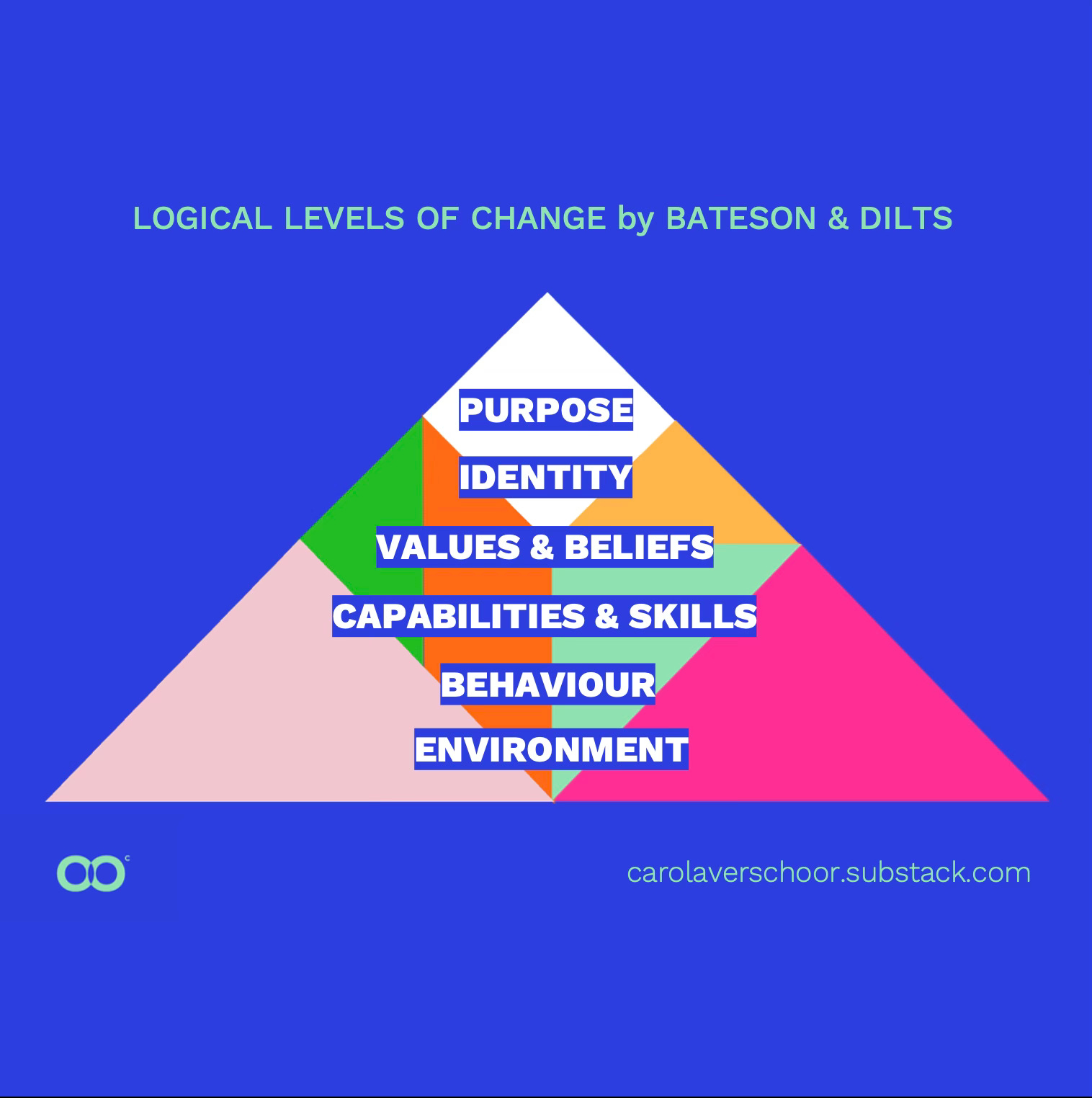
The model consists of six levels, each representing a different aspect of change:
1. Environment: This level encompasses the external context in which we operate, including physical surroundings and social conditions. It highlights the importance of creating an environment conducive to change, as the basis for a “new normal”. We can explore this level through the questions: where, when and with whom. For example: where and when are we operating as a design team? with whom are we interacting through our brand?
2. Behavior: Here, we focus on specific actions and reactions. Change at this level involves altering habits and practices to achieve desired outcomes. It addresses our behaviours as expressions and interactions. We can learn from this level by examining the what space: what are we currently doing/thinking/feeling? what might we do differently?
3. Capabilities: This level pertains to the skills and competencies we possess and those we need to develop. Enhancing capabilities can empower individuals and teams to innovate and adapt effectively. This level looks at skills: which skills are most helpful ? what isn’t working and why not? what might we do better? what do we still need to learn?
4. Beliefs and Values: At this level, we explore the underlying beliefs and values that drive our actions. Values and beliefs shape our understanding of ourselves, others, and the world, influencing how we find meaning in events. Shifting beliefs can lead to profound changes in behaviour and motivation. They are the driving force behind our motivation and culture, guiding our actions and capabilities. They answer the essential question of why? and can inspire our creative journey by empowering us to express our transformative vision and make a meaningful impact.
5. Identity: This level addresses how we perceive ourselves and our roles. A robust sense of identity not only fuels commitment but also fosters resilience. It relates to our sense of who we are. Our identity shapes how we view ourselves and our roles within the broader ecosystems. It is this perception that harmonizes our beliefs, capabilities, and behaviors into a cohesive framework, driving us toward our purpose.
Cultivating a strong identity can be a transformative strategy, enabling teams to navigate challenges with confidence and clarity.
6. Purpose: The highest level, purpose, reflects our overarching mission and vision. Aligning change initiatives with a clear purpose can galvanize collective action and foster a sense of meaning. Purpose contains the understanding that we are a subsystem of larger systems. Our experience of this level is related to our sense of purpose, vision and mission. It can be understood by asking the questions: For whom? and For what?, realising that transformation is the result of a transformative experience that changes the way we view ourselves and the way we view our world.
This model encourages a holistic approach to change, recognizing that true transformation often requires shifts in mindset, identity, and purpose, not just surface-level adjustments.
The Transition Model by William Bridges
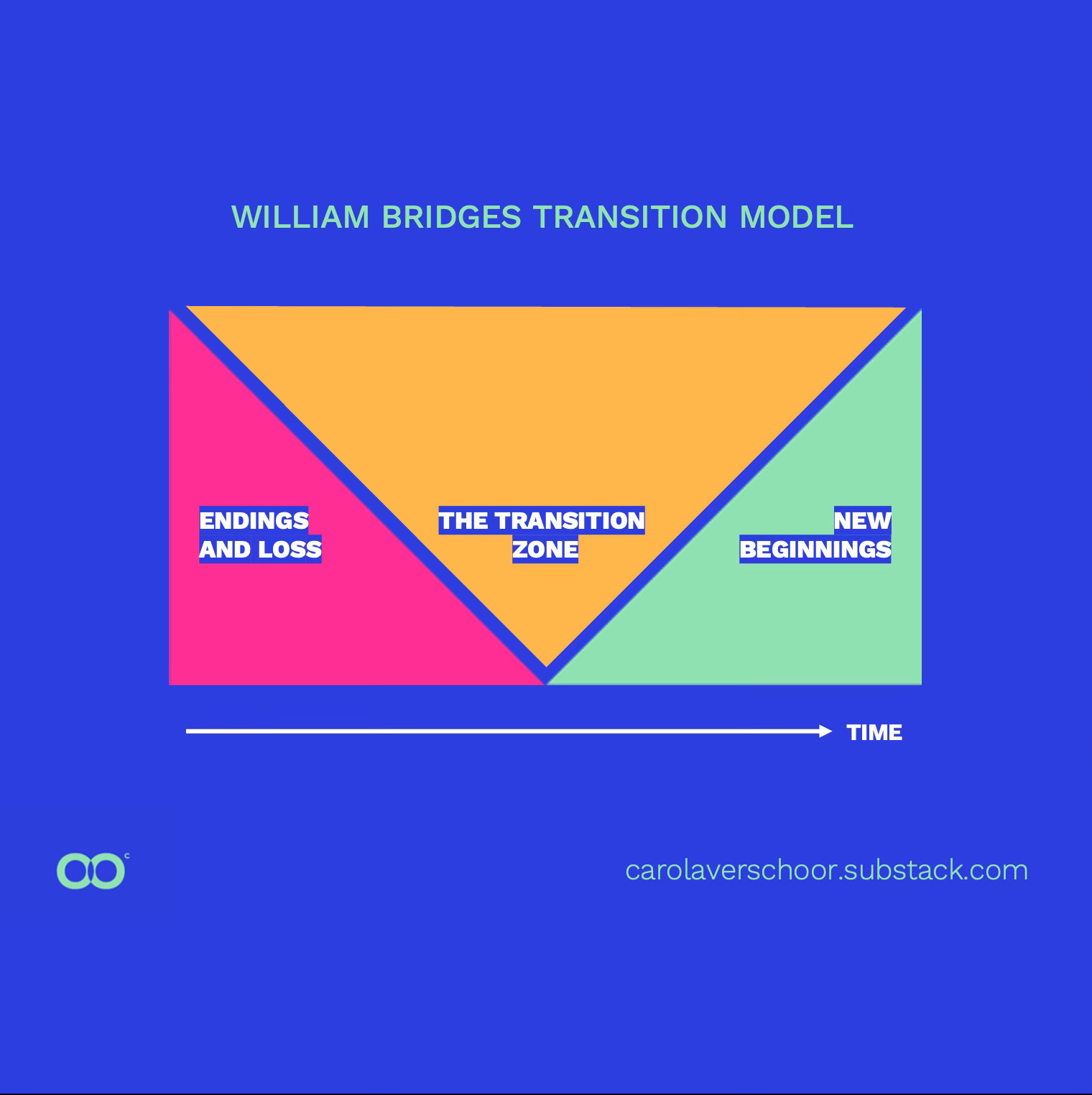
The Bridges Transition Model serves as a guide for organizations and individuals navigating change. It dives into the personal and emotional journey that accompanies transformation, breaking it down into three distinct stages: the poignant farewell to the familiar in Ending What Currently Is, the uncertain yet fertile ground of The Transition Zone, and the hopeful emergence of The New Beginnings. This model empowers us to embrace change with greater understanding and resilience, fostering a more human-centered approach to the (r)evolution we all face.
Endings: The Catalyst for Change
Every transition begins with an ending, a truth that may seem paradoxical yet holds profound significance. It is also the topic of this post, where I talk about where transformation begins. This initial phase invites individuals to confront their losses, recognizing what we must leave behind. It’s a moment of reflection where we discern which relationships, processes, team dynamics, or locations will remain part of our journey. The endings phase involves acknowledging change and letting go of unhelpful aspects of the current situation. It’s crucial to communicate openly, provide support and opportunities for individuals to express feelings and concerns. Addressing our emotions helps facilitate understanding and acceptance, saying goodbye to the old so that transformation can unfold.
The Transition Zone: A Space of Transformation
Following the act of letting go, we enter the transition zone—a liminal space where the old has faded, but the new has yet to fully emerge. This period is crucial, as it is here that individuals undergo essential psychological shifts and realignments. It’s a time of uncertainty, where the familiar fades and the contours of a new identity begin to take shape. In this state of flux, individuals may experience confusion and distress, yet it is also the fertile ground for new beginnings to sprout.
The transition zone can be uncomfortable, yet it offers significant opportunities for us to explore new possibilities and redefine our identity. Providing guidance, support, and resources is essential during this time for innovation to thrive in the last phase. A supportive environment helps us feel secure and confident in adapting to new circumstances and daring to experiment and try new things.
New Beginnings: Embracing Fresh Possibilities
As we step into new beginnings, we embrace fresh understandings, values, and attitudes. This phase is characterized by a surge of energy directed toward new horizons—a vibrant expression of a renewed identity. When transitions are navigated thoughtfully, individuals can redefine their roles with clarity, understanding their purpose and how best to contribute. This leads to a sense of reorientation and revitalization, empowering them to engage fully in their new reality.
The new beginnings phase is marked by excitement and optimism as individuals embrace change. Celebrating achievements and recognizing contributions are vital to maintaining momentum and enthusiasm, helping everyone adapt and thrive in the new environment. Acknowledging success stories reinforces positive aspects of the change process. Rituals are essential for bringing us together in the transformation.
This model brings the human dimension of transformation into view, acknowledging that it is a process of awareness, mindset and adaptation.
The Three Horizons by Bill Sharpe
The third model is the Three Horizons Framework by Bill Sharpe. I love the subtitle of his book: Three Horizons - Patterning for Hope. The Three Horizons is a straightforward framework designed to help individuals and teams envision the future. It acknowledges that differing perspectives on future possibilities can lead to intense disagreements. By using this framework, we can engage in meaningful discussions about future aspirations, whether in team settings, organizations, or broader societal contexts. It encourages constructive dialogue, fostering collaboration and understanding among diverse viewpoints.
As a strategic planning tool it is designed to help organizations envision and navigate future possibilities and transformation. It categorizes future developments into three distinct horizons, each representing different time frames and levels of uncertainty.
Horizon 1 represents the present and the immediate future, focusing on current practices and incremental improvements. Teams operating in this horizon are primarily concerned with optimizing existing processes, addressing current challenges, and maximizing short-term performance. This horizon emphasizes stability and efficiency, often relying on established business models and practices.
Horizon 2 looks at the near to mid-term future, where teams begin to explore emerging trends and innovations. This horizon is characterized by experimentation and adaptation, as teams seek to identify new opportunities that could disrupt or enhance their current practices. It involves a degree of risk-taking and the willingness to invest in new ideas that may not yet be fully developed or understood. Teams in this horizon are often in a transitional phase, balancing their existing capabilities with the need to innovate.
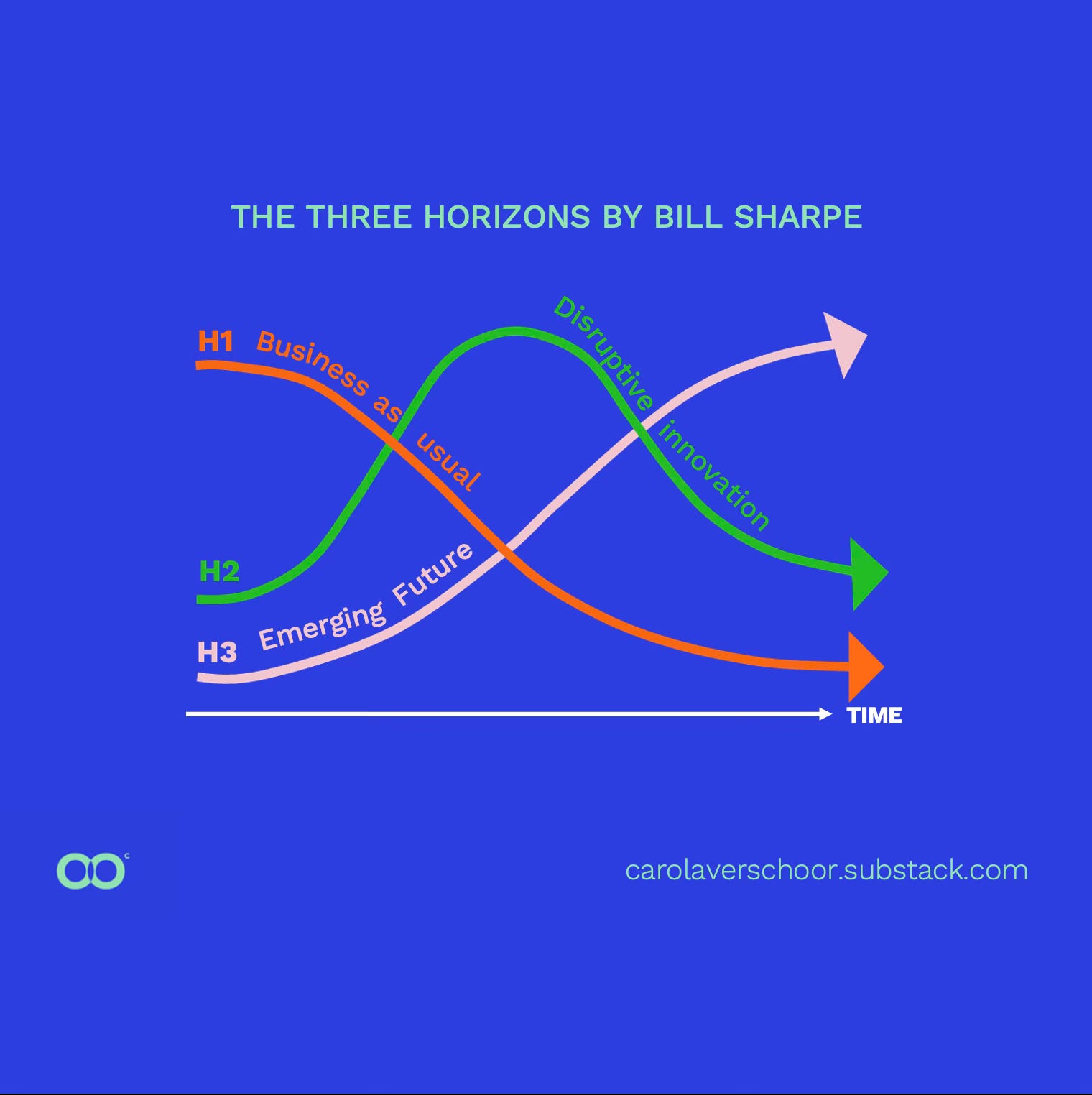
Horizon 3 focuses on the long-term future, envisioning transformative changes that could redefine the organization or its industry. This horizon is marked by high uncertainty and potential disruption, as it involves exploring radical innovations and new paradigms. Teams must think creatively and strategically, considering how societal, technological, and environmental shifts could impact their future. Horizon 3 encourages visionary thinking and the development of new business models that may not yet be feasible but are essential for long-term sustainability.
Overall, the Three Horizons Framework helps teams balance their current practices with future possibilities, fostering a proactive approach to strategic planning and transformation design.
Transformation is a verb
While each of these frameworks is super useful in itself, they all point to the importance of doing. Transformation is increasingly necessary to adapt to the rapid and multifaceted changes in our world. Each model offers unique insights into navigating change, emphasizing the importance of collaboration, emotional understanding, and a clear purpose. By addressing various levels of human experience and future possibilities, these frameworks help us foster resilience, innovation, and a proactive approach to transformation, ultimately enabling us to thrive in an ever-evolving landscape. Models help, but in the end transformation is a verb. In the words of Leonardo da Vinci: “It had long since come to my attention that people of accomplishment rarely sat back and let things happen to them. They went out and happened to things.” May these models serve as inspiration for us to co-create transformation for a better, kinder and more prosperous world for all.