

Transformational Intelligence: Redefining AI and Human Potential for a Better Future
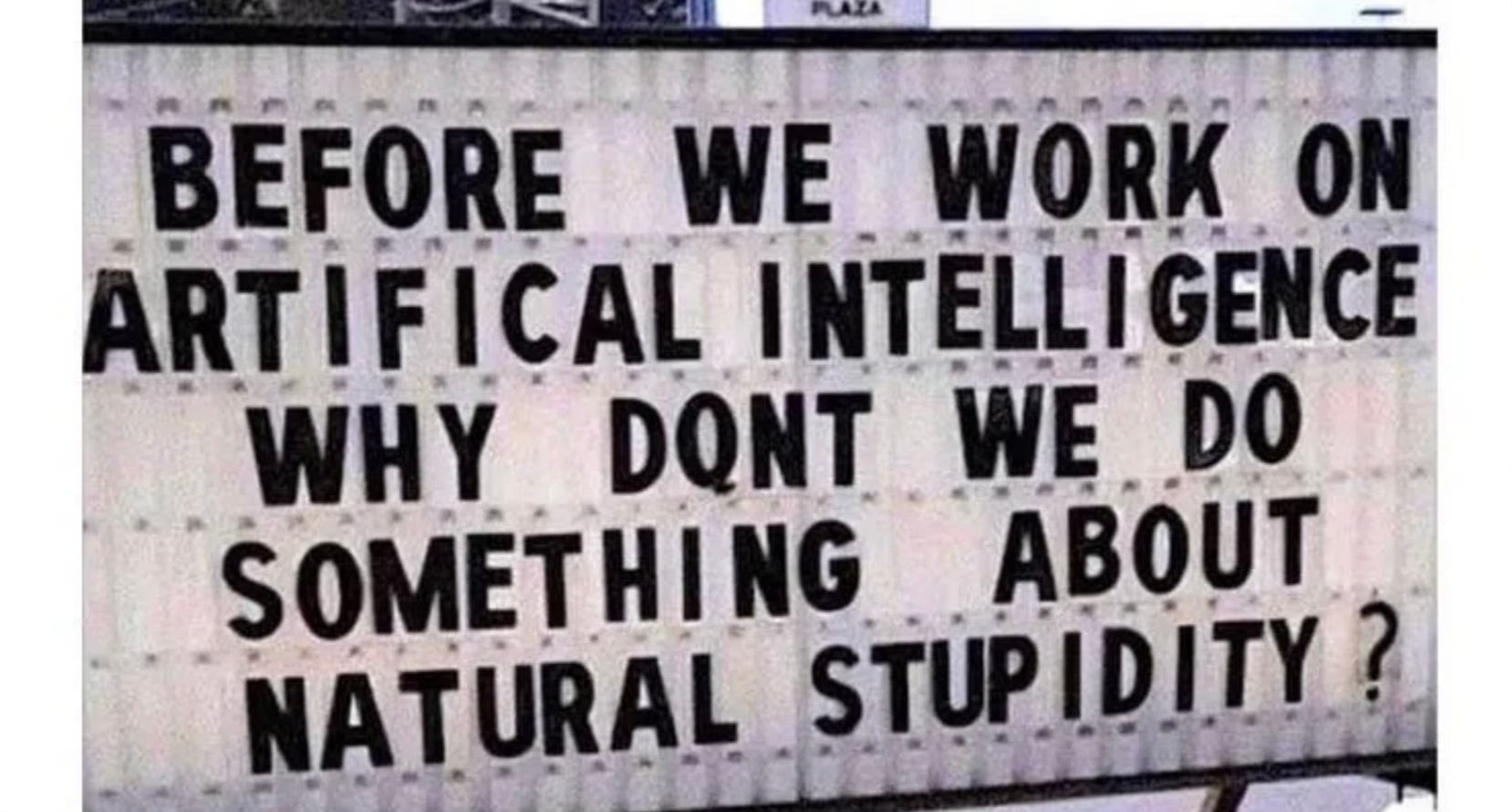
👾We've all seen the meme about "natural stupidity"... what if instead of Artificial Intelligence we seek Transformational Intelligence? Designing through intentional actions for a better future.

There is this famous meme, which goes: “Better to have artificial intelligence than natural stupidity.” Are we overlooking artificial stupidity, though? Anything that fails to recognize the bigger system eventually becomes alienated from the whole. So how might we bring more integrative logic into the future of AI to help transform it in ways that are of service to life and our living planet?
The future of artificial intelligence (AI) and human talent is being reimagined in ways that range from dystopian and scary all the way to empowering and inspiring. Intelligence is often poorly defined, as it cannot simply be about creating smarter machines or automating tasks. That would confine it to industrial and mechanistic thinking, which is so 1990… I wonder whether we can look at its potential through the lens of transformation, leveraging intelligence on how we relate to the very fabric of society, technology, and our role in it. An emerging concept, that captures this shift for me, is the idea of Transformational Intelligence, which might be a way of navigating towards a future where human creativity, emotional intelligence, and advanced AI converge to address the greatest challenges of our time. Sounds utopian perhaps, but let me explain.
The idea of Transformational Intelligence envisions a future where technological advancement is not solely measured by computational power or efficiency but by its capacity to catalyze human flourishing, ethical decision-making, and sustainable development. In this new paradigm, we aren’t just ‘thinking’ like machines, but bringing in our multiple-intelligences to reconsider how human behaviors, societal systems, and technology can co-evolve toward a world that is kinder, more mindful, and fundamentally prosperous for all.
Thinking, Feeling and Multiple Intelligences
The super talented Portuguese Neuroscientist Antonio Damasio puts it simply and succinctly: “We are not thinking machines that feel, we are feeling machines that think.” Humans are sensing beings. Our intelligence is comprised of emotions and feelings, as well as logic, the shape our thoughts, our decisions, and our actions and behaviours. By seeing ourselves this way, we don’t limit ourselves to a mechanistic view but rather integrate and include our emotional intelligence for deeper self-awareness, empathy, and co-creative approach to life.
Howard Gardner's theory of multiple intelligences proposes that intelligence is not a single general ability but consists of distinct types, such as linguistic, logical-mathematical, spatial, musical, bodily-kinesthetic, interpersonal, intrapersonal, and naturalistic, each representing unique cognitive strengths. This is complex, layered and as messy as Gardner’s home office in the photo below, which I love in all its humanity and beauty. In his latest writings, Gardner introduces the concept of the “synthesizing mind”—the ability to survey experiences and data across a wide range of disciplines and perspectives. Our capacity to do so resides in the integrative, experiential aspect of our intelligence. It is not just 1+1 = 2. It’s more like 1+1 = 11. It’s generative, integrative, creative and draws from everything out there to “see” the world and perceive it through the lens of our talents and possibilities.

So, what does this have to do with AI? It’s hinting at the obvious: we must look at AI as one of many forms of intelligence. We are sentient beings on a planet that is alive. Why would we reduce ourselves to thought?
“Don't Believe Everything You Think!” is a famous quote by Robert Fulghum, author of “All I Really Need to Know I Learned in Kindergarten”. There is more simplicity in complexity than we actually believe, but you need to bring your synthesizing mind into play. We are a constellation of thoughts, feelings, sensations. Just like the planet around us. Can we be more open-minded, open-hearted and connected to life? And if so, how might we do that?
These are the things Fulghum learned (in Kindergarten):
1. “Share everything.”
2. “Play fair.”
3. “Don't hit people.”
4. “Put things back where you found them.”
5. “Clean up your own mess.”
6. “Don't take things that aren't yours.”
7. “Say you're sorry when you hurt somebody.”
8. “Wash your hands before you eat.”
9. “Flush.”
10. “Warm cookies and cold milk are good for you.”
11. “Live a balanced life - learn some and drink some and draw some and paint some and sing and dance and play and work everyday some.”
12. “Take a nap every afternoon.”
13. “When you go out into the world, watch out for traffic, hold hands, and stick together.”
14. “Be aware of wonder. Remember the little seed in the Styrofoam cup: The roots go down and the plant goes up and nobody really knows how or why, but we are all like that.”
15. “Goldfish and hamster and white mice and even the little seed in the Styrofoam cup - they all die. So do we.”
16. “And then remember the Dick-and-Jane books and the first word you learned - the biggest word of all - LOOK.”
One may or may not agree with this list. It’s from 1986 after all. Ancient at the rate things are developing. But the point is, there is a sentience to this, which makes it relatable and human. And we need more of that in this world.
Redefining Intelligence for Life-Centric Transformation
So let’s bring in a bit of flip-thinking, to help transform problems into opportunities. Can we then, by design, redefine AI to align more closely with life-centered values, creating a symbiosis between the human mind and machine intelligence to serve the world?
Intentionality in design refers to the deliberate and purposeful decisions made throughout the design process, aimed at achieving specific goals, values, or outcomes. It involves clear intention behind every choice, from the overall concept to the smallest details, ensuring that the design serves a defined purpose and addresses user needs effectively. Intentional design focuses on aligning decisions with the desired impact, whether it’s improving user experience, solving a problem, or fostering a particular emotion or behaviour. This approach ensures that design is not random, but thoughtfully crafted to create value and meaning. Let’s apply this approach to our relationship with technology.
🛤️ Moving Beyond Design Thinking to Transformation Design
Design thinking has long been celebrated as a method for solving complex problems by centering the user experience and focusing on empathy and creativity. While it has led to many breakthroughs and I use it in many ways in my everyday practice, in the age of Transformational Intelligence, design thinking alone is not enough. What is needed now is a more comprehensive approach—’Design Living’ or ‘Design Behavioring’—where the focus is not just on creating solutions but on transforming how we live, interact, and behave in response to the systems we design.
Design Living is about embedding design into the very way we exist in the world. It implies that every action, decision, and system we build must align with larger values of sustainability, kindness, and shared prosperity. It’s about designing with the long-term well-being of humanity and life in mind, not just for immediate convenience or economic gain. Or more likes and followers. For example, designing cities that are not only technologically advanced but also enhance community, mental well-being, and environmental harmony.
Technology should not be an end in itself, but a means to support a way of living that nurtures both human potential and the ecosystems we depend on. It’s a shift from design as a problem-solving tool to design as a transformational way of being in the world.
So many questions!
Transformational intelligence is generative. It opens space for new questions, such as:
What would happen if we transformed ourselves by exploring our world through integrative, transformational intelligence instead of exploiting each other through materialism?
What might the world look like if we would co-create systems instead of consuming stuff?
How might humanity evolve if we combined AI's deep logical processing with our broad intelligence to create more compassionate systems of governance and innovation?
What could we achieve if AI's computational power was harnessed to amplify human empathy and creativity, rather than purely optimizing for efficiency?
How would our societies change if AI became a partner in nurturing holistic well-being, blending data-driven insights with life-centered values? And dare I say, helping us come up with new questions about the correlation and causality of our well-being?
What new possibilities might emerge if AI helped us to recognize and solve global challenges through collective wisdom, rather than focusing on short-term individual gains?
🌐 Systems Change for a Better, Kinder World
At the heart of Transformational Intelligence is the idea of systems change. As we move forward, it’s crucial to recognize that the challenges we face—climate change, inequality, political instability—are not isolated problems. They are deeply interconnected and require solutions that operate at the system level. This means rethinking not only the technologies we build but also the social, economic, and political systems that underpin them.
In this vision, AI and human ingenuity work hand in hand to catalyze system-wide transformations that lead to a more equitable and sustainable world. It’s not just about creating new technologies but about reshaping our institutions, our policies, and even our mindsets. For instance, AI could be used to model and simulate more equitable resource distribution systems, while human leaders focus on creating policies that foster shared prosperity and resilience.
This systems change approach also extends to how we think about talent and human potential. Instead of merely training people to adapt to a technology-driven world, we focus on cultivating the full spectrum of human capabilities—empathy, creativity, critical thinking, and ethical reasoning. Empowering people not just to survive in the future but to actively shape it for good. This orchestration capacity requires a level of thinking that is beyond AI. While AI learns fast: its intelligence is deep, and we need a broader perspective.
Systemic thinking considers the interconnectedness of components within a larger system. Instead of focusing on individual elements in isolation, systemic thinking looks at the relationships, patterns, and behaviors that emerge when these components interact. This integrative approach helps to identify root causes, predict outcomes, and design solutions that account for the broader context. The very core of Transformational Intelligence. It involves:"
Understanding the Whole System: exploring the system as a whole—its components, interactions, feedback loops, and constraints. This broad understanding ensures that what we design is not just addressing symptoms but is aligned with the system's overall needs and goals in an intentional way.
Identifying Leverage Points: for design resilience that is transformative we must pinpoint key leverage points—areas where small changes can lead to significant improvements across the system. This allows for more impactful solutions that maximize positive outcomes for all.
Considering Long-Term Effects: A systemic approach to design takes into account both short-term and long-term consequences of a solution. Considering how solutions will affect other parts of the system, ensuring sustainability and avoiding -as much as possible- any unintended negative consequences.
Interdisciplinary Collaboration: Since systems are often complex, systemic thinking encourages collaboration across disciplines, bringing together diverse perspectives to create well-rounded solutions. And is achieved across several levels (knowing, feeling, sensing).
Iterative Feedback and Adaptation: With transformational intelligence, the design process is more dynamic, involving constant feedback and iteration. Ideas and solutions are iterated and re-designed by observing how changes affect the system as a whole.
Transformational intelligence helps to design solutions that fit into and improve the larger system, rather than merely optimizing isolated components. It encourages a deeper understanding of interdependencies, creating sustainable, effective solutions that are capable of addressing complex, interconnected problems.
Real transformation goes beyond the hype
In an era in which AI is poised to reshape nearly every aspect of our lives, the concept of Transformational Intelligence integrates technological advancement with deep human values. It challenges us to rethink AI not as a separate entity with “artificial stupidity” but as one of many tools for collective transformation where human potential and techno-logical logic work in harmony to create a kinder, more prosperous world. Ultimately, the future is not about machines—it’s about transformation, ingenuity, systems change, and the collective potential of humanity to create a world that is meaningful and viable for everyone.
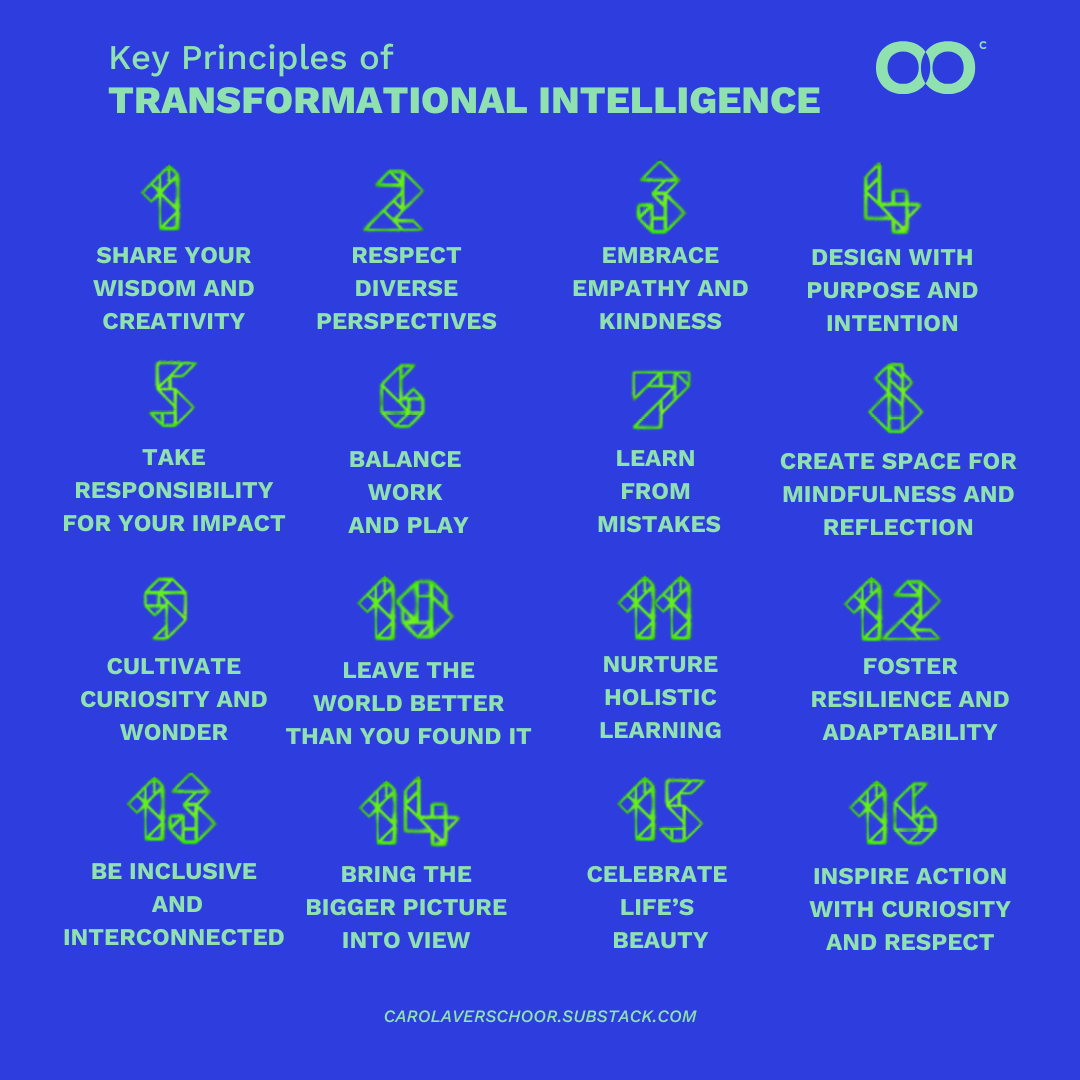
Might we then look at Fulghum’s Kindergarten Principles in a new light? Here’s an attempt to summarise what we can learn while AI is still in Kindergarten! In other words, Key Principles for Transformational Intelligence:
1/ Share your wisdom and creativity – Collaborate and co-create for collective benefit.
2/ Respect diverse perspectives – Value all forms of intelligence, from logic to emotion.
3/ Embrace empathy and kindness – Treat others with care, understanding, and compassion.
4/ Design with purpose and intention – Ensure every decision serves a greater, life-affirming goal.
5/ Take responsibility for your impact – Own the consequences of your actions and design for the whole system.
6/ Balance work and play – Integrate logic with intuition, action with reflection, structure with spontaneity.
7/ Learn from mistakes – View failure as an opportunity for growth and transformation.
8/ Create space for mindfulness and reflection – Incorporate time for pause and recalibration in daily life.
9/ Cultivate curiosity and wonder – Approach life and challenges with a sense of awe and openness.
10/ Leave the world better than you found it – Contribute positively to the environment, society, and relationships.
11/ Nurture holistic learning – Evolve through continuous, mindful learning that integrates mind, body, and heart.
12/ Foster resilience and adaptability – Develop systems and behaviors that thrive in change and uncertainty.
13/ Be inclusive and interconnected – Design solutions that enhance collaboration and interconnectedness, both human and technological.
14/ Bring the bigger picture into view– See beyond the immediate and think systemically about long-term effects.
15/ Celebrate life’s beauty – Acknowledge the beauty and mystery in the simplest moments and creations.
16/ Inspire action with curiosity and respect – Explore and innovate with a sense of discovery, embracing the unknown and unknowable, respecting life in all its forms.
Let’s do this!
If you enjoyed this article, please leave a ‘♡’ and/or share it with others. You may also like:
Respecting Transformation: Changing Lenses, Changing Outcomes

Transformation is often depicted as a sweeping overhaul—a dramatic change that alters everything overnight. However, true transformation begins not with action, but with a shift in perception. To redesign the systems we inhabit in response to the challenges of a polycrisis—climate change, inequality, technological disruption, and geopolitical instabilit…
